 Tirulator
Educational Center – Common Terms and Glossary
Tire and Wheel Size Explained: Your Complete Guide.
How to Read Tire Size
Reading a tire size involves decoding an alphanumeric string stamped on the tire sidewall. Sidewall of your tire is like a passport, providing crucial details about its dimensions, type, and performance. Understanding these markings is essential for finding the right tires for your vehicle and driving requirements.
Example: P225/70R16 91S
- P: Tire Type – This indicates the tire is a P-Metric tire, designed for passenger vehicles. LT means light truck, ST means Special Trailer, and T means a temporary spare.
- 225: Tire Width – The width of the tire in millimeters, measured from sidewall to sidewall. In this case, the tire is 225 millimeters wide.
- 70: Aspect Ratio – This number represents the tire's height (from the rim to the tread) as a percentage of its width. Here, the height is 70% of the 225 mm width.
- R: Construction – Stands for radial construction, the most common type for modern vehicles.
- 16: Rim Diameter - This is the diameter of the wheel in inches that the tire is designed to fit.
- 91: Load Index – This assigned code indicates the maximum weight a tire can carry at its specified pressure.
- S: Speed Rating – A letter indicating the maximum speed a tire is designed to handle safely under specific conditions.
Tire Type
Common tire type prefixes:
- P – Passenger car.
- LT – Light truck.
- ST – Special trailer.
- C – Commercial van tire.
- XL / HL / Reinforced – Tires designed to carry higher loads than standard tires of the same size.
- T – Temporary spare tire.
Tire Construction Types
The three main types of tire construction are: radial, bias-ply (cross-ply), and belted bias.
Radial Tires: The body plies run straight across, from bead to bead, at a 90-degree angle to the tread centerline, perpendicular to the direction of travel, with stabilizing steel or fabric belts under the tread. These tires are standard on almost all modern passenger cars, trucks, and SUVs. Radial tires feature lower rolling resistance, better fuel economy, longer tread life, and higher high-speed stability.
Bias-Ply (Cross-Ply) Tires: The cords in the body plies run in an overlapping criss-cross pattern (usually at an angle of 30 to 45 degrees) from bead to bead. These tires are used in vintage vehicles, heavy-duty off-road equipment, and agricultural or industrial applications. They feature thick, rigid sidewalls, providing strong resistance to punctures. However, bias-ply tires have a higher rolling resistance and wear out faster at highway speeds.
Belted Bias Tires: These tires have a traditional bias-ply carcass with added stabilizing steel or fiber belts directly underneath the tread. Belted bias tires are less efficient compared to standard radial tires, but they offer a stiffer tread area for better high-speed performance compared to regular bias-ply tires. For this reason, these tires were commonly used in older classic muscle cars.
Tire Width
The Width of a tire, measured in millimeters, directly impacts its contact patch with the road. A wider tire typically offers improved grip, better handling, and a more visually appealing appearance. The more rubber in contact with the road, the better the grip, especially in dry conditions and during acceleration or braking. Wider tires can enhance cornering stability and responsiveness, but they may also increase rolling resistance and slightly reduce fuel efficiency.
Aspect Ratio
The Aspect Ratio represents the sidewall height as a percentage of the tire's width. A 225 mm width tire with a higher aspect ratio (e.g. 70) will have a taller sidewall, while a lower aspect ratio (e.g. 45), will have shorter sidewall. This value helps ensure proper fit of the wheel and adequate clearance in the vehicle's wheel well.
Load Index
The Load Index is a numerical representation found on the tire sidewall, indicating the maximum load that each tire is designed to support when inflated to its recommended pressure. Always opt for tires with a load index that matches or surpasses the manufacturer's guidelines for your vehicle.
Load index chart
| Load index | Max Weight (kg) | Max Weight (lbs) |
|---|---|---|
| 51 | 195 | 430 |
| 52 | 200 | 441 |
| 53 | 206 | 454 |
| 54 | 212 | 467 |
| 55 | 218 | 481 |
| 56 | 224 | 494 |
| 57 | 230 | 507 |
| 58 | 236 | 520 |
| 59 | 243 | 536 |
| 60 | 250 | 551 |
| 61 | 257 | 567 |
| 62 | 265 | 584 |
| 63 | 272 | 600 |
| 64 | 280 | 617 |
| 65 | 229 | 639 |
| 66 | 300 | 661 |
| 67 | 307 | 677 |
| 68 | 315 | 694 |
| 69 | 325 | 717 |
| 70 | 335 | 739 |
| 71 | 345 | 761 |
| 72 | 355 | 783 |
| 73 | 365 | 805 |
| 74 | 375 | 827 |
| 75 | 387 | 853 |
| 76 | 400 | 882 |
| 77 | 412 | 908 |
| 78 | 425 | 937 |
| 79 | 437 | 963 |
| 80 | 450 | 992 |
| 81 | 462 | 1019 |
| 82 | 475 | 1047 |
| 83 | 487 | 1074 |
| 84 | 500 | 1102 |
| 85 | 515 | 1135 |
| 86 | 530 | 1168 |
| 87 | 545 | 1202 |
| 88 | 560 | 1235 |
| 89 | 580 | 1279 |
| 90 | 600 | 1323 |
| 91 | 615 | 1356 |
| 92 | 630 | 1389 |
| 93 | 650 | 1433 |
| 94 | 670 | 1477 |
| 95 | 690 | 1521 |
| 96 | 710 | 1565 |
| 97 | 730 | 1609 |
| 98 | 750 | 1653 |
| 99 | 775 | 1709 |
| 100 | 800 | 1764 |
| 101 | 825 | 1819 |
| 102 | 850 | 1874 |
| 103 | 875 | 1929 |
| 104 | 900 | 1984 |
| 105 | 925 | 2039 |
| 106 | 950 | 2094 |
| 107 | 975 | 2150 |
| 108 | 1000 | 2205 |
| 109 | 1030 | 2271 |
| 110 | 1060 | 2337 |
| 111 | 1090 | 2403 |
| 112 | 1120 | 2469 |
| 113 | 1150 | 2535 |
| 114 | 1180 | 2601 |
| 115 | 1215 | 2679 |
| 116 | 1250 | 2756 |
| 117 | 1285 | 2833 |
| 118 | 1320 | 2910 |
| 119 | 1360 | 2998 |
| 120 | 1400 | 3086 |
| 121 | 1450 | 3197 |
| 122 | 1500 | 3307 |
| 123 | 1550 | 3417 |
| 124 | 1600 | 3527 |
| 125 | 1650 | 3638 |
| 126 | 1700 | 3748 |
| 127 | 1750 | 3858 |
| 128 | 1800 | 3968 |
| 129 | 1850 | 4079 |
| 130 | 1900 | 4189 |
| 131 | 1950 | 4299 |
| 132 | 2000 | 4409 |
| 133 | 2060 | 4542 |
| 134 | 2120 | 4674 |
| 135 | 2180 | 4806 |
| 136 | 2240 | 4938 |
| 137 | 2300 | 5071 |
| 138 | 2360 | 5203 |
| 139 | 2430 | 5357 |
| 140 | 2500 | 5512 |
| 141 | 2575 | 5677 |
| 142 | 2650 | 5842 |
| 143 | 2725 | 6007 |
| 144 | 2800 | 6173 |
| 145 | 2900 | 6393 |
| 146 | 3000 | 6614 |
| 147 | 3075 | 6779 |
| 148 | 3150 | 6945 |
| 149 | 3250 | 7165 |
| 150 | 3350 | 7385 |
Speed Rating
The Speed Rating is an alphabetical code on a tire, indicating the maximum speed a tire is designed to handle safely under specific conditions.
Speed rating chart for passenger cars
| Speed Symbol | Speed (kmph) | Speed (mph) |
|---|---|---|
| E | 70 | 43 |
| F | 80 | 50 |
| G | 90 | 56 |
| J | 100 | 62 |
| K | 110 | 68 |
| L | 120 | 75 |
| M | 130 | 81 |
| N | 140 | 87 |
| P | 150 | 94 |
| Q | 160 | 100 |
| R | 170 | 106 |
| S | 180 | 112 |
| T | 190 | 118 |
| U | 200 | 124 |
| H | 210 | 130 |
| V | 240 | 149 |
| W (ZR*) | 270 | 168 |
| Y (ZR*) | 300 | 186 |
* Tires capable of speeds over 240 km/h (149 mph) may include "ZR" in their size designation. For those with speeds over 300 km/h (186 mph), "ZR" is mandatory.
Tire Sizing Systems
Different regions and vehicle types use different tire sizing systems. It is important to understand these differences in order to choose the correct tires for your vehicle. Let's learn about the most common tire sizing systems.
P-Metric Sizing System
The P-Metric system, introduced in 1976, is widely used for passenger vehicles in North America. It combines metric measurements, such as tire width in millimeters, with imperial units, such as rim diameter in inches. P-Metric tires are designed to have lower rolling resistance and higher inflation pressure compared to older tire sizing systems.
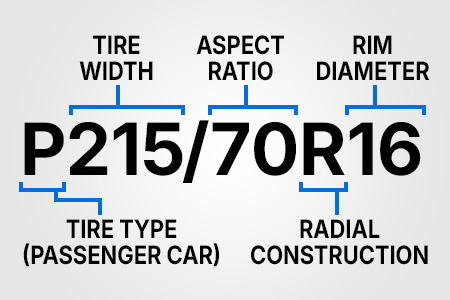
Example: P215/70R16
ISO Metric Sizing System
The ISO (International Organization for Standardization) Metric system is used globally and combines metric measurements with a service description that includes the load index and speed rating.
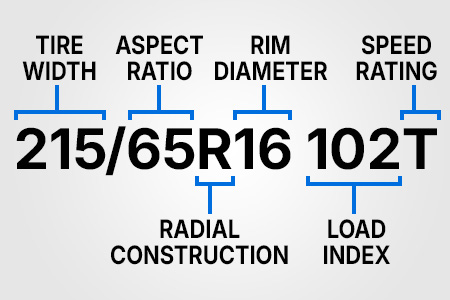
Example: 215/65R16 102T
LT-Metric Sizing System
The LT-Metric tire system is similar to the P-Metric system, but is specifically designed for light trucks. Instead of the "P" designation, the LT designation indicates that the tire can handle higher loads and pressures typically associated with trucks.
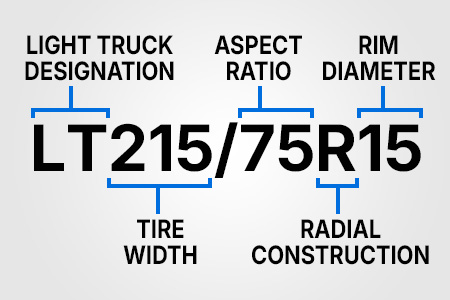
Example: LT215/75R15
Light Truck Numeric Sizing System
The Light Truck Numeric system employs a combination of numbers and alphabetic characters to represent tire size, similar to the P-Metric system.
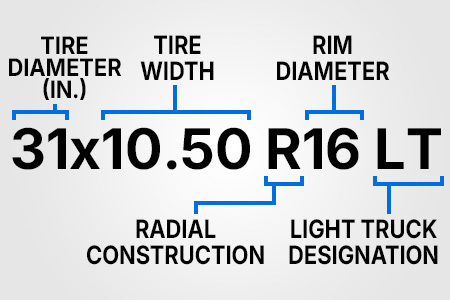
Example: 31x10.50 R16 LT